

How to calculate the stress distribution in an internal gear?
Oct 29, 2025
As a trusted internal gear supplier, understanding how to calculate the stress distribution in an internal gear is of paramount importance. This knowledge not only allows us to design and manufacture high - quality internal gears but also helps our customers make informed decisions about gear selection for their specific applications. In this blog, we will delve into the methods and factors involved in calculating the stress distribution in an internal gear.
Basics of Internal Gears
Internal gears are a type of gear where the teeth are cut on the inner surface of a ring. They are commonly used in applications such as planetary gear systems, where they can provide a compact and efficient way to transfer power. Compared to external gears, internal gears have some unique characteristics in terms of stress distribution due to their geometry.
The main types of stresses that an internal gear experiences include bending stress, contact stress, and shear stress. Bending stress occurs at the root of the gear teeth when the gear is transmitting torque. Contact stress is generated at the contact area between the mating teeth, and shear stress is related to the forces acting parallel to the cross - section of the gear teeth.
Factors Affecting Stress Distribution
Several factors influence the stress distribution in an internal gear. These include:
- Geometry of the Gear: The shape, size, and number of teeth of the internal gear play a crucial role. For example, a gear with a larger number of teeth generally has a lower bending stress at the tooth root compared to a gear with a smaller number of teeth. The pitch diameter, addendum, and dedendum also affect the contact and bending stresses.
- Material Properties: The mechanical properties of the gear material, such as its modulus of elasticity, yield strength, and ultimate tensile strength, have a significant impact on stress distribution. A material with a higher modulus of elasticity will deform less under load, resulting in different stress patterns compared to a more compliant material.
- Load Conditions: The magnitude, direction, and type of load applied to the gear are important factors. A constant load will produce a different stress distribution compared to a cyclic or variable load. In addition, the way the load is applied, whether it is a single - point load or a distributed load, also affects the stress levels.
- Manufacturing Accuracy: The precision of gear manufacturing, including tooth profile accuracy, surface finish, and concentricity, can influence stress distribution. Imperfections in the tooth profile can lead to uneven load distribution and increased stress concentrations.
Analytical Methods for Calculating Stress Distribution
Bending Stress Calculation
One of the most common methods for calculating the bending stress in gear teeth is the Lewis formula. The Lewis formula for bending stress ($\sigma_b$) is given by:
[ \sigma_b=\frac{F_t}{b\cdot m\cdot Y} ]
where $F_t$ is the tangential force acting on the gear tooth, $b$ is the face width of the gear, $m$ is the module of the gear, and $Y$ is the Lewis form factor, which depends on the number of teeth and the tooth profile.
However, the Lewis formula is a simplified method and has some limitations. It assumes a uniform load distribution along the tooth width and a static load condition. For more accurate results, especially for high - precision applications, finite element analysis (FEA) can be used.
Contact Stress Calculation
The Hertzian contact theory is often used to calculate the contact stress between two mating gear teeth. The maximum contact stress ($\sigma_H$) between two cylinders (which can be used to approximate the contact between gear teeth) is given by:
[ \sigma_H=\sqrt{\frac{F_t}{\pi\cdot b}\cdot\frac{\frac{1}{R_1}+\frac{1}{R_2}}{\frac{1 - \nu_1^2}{E_1}+\frac{1 - \nu_2^2}{E_2}}} ]
where $R_1$ and $R_2$ are the radii of curvature of the two contacting surfaces, $\nu_1$ and $\nu_2$ are the Poisson's ratios of the two materials, and $E_1$ and $E_2$ are the moduli of elasticity of the two materials.
Similar to bending stress calculation, the Hertzian theory has its limitations. It assumes that the contacting surfaces are smooth and the materials are linearly elastic. In real - world applications, FEA can provide more accurate results by taking into account the actual geometry, material properties, and load conditions.
Finite Element Analysis (FEA) for Stress Distribution
FEA is a powerful numerical method for calculating stress distribution in internal gears. It involves dividing the gear into a large number of small elements (finite elements) and solving the equations of equilibrium for each element.
The first step in FEA is to create a 3D model of the internal gear. This model should accurately represent the geometry of the gear, including the tooth profile, fillets, and any other features. The material properties of the gear are then assigned to the model.
Next, the boundary conditions and loads are applied to the model. The boundary conditions define how the gear is constrained, such as fixed supports or rotational constraints. The loads can be applied as forces or torques.
Once the model is set up, the FEA software solves the equations to calculate the stress distribution throughout the gear. The results are usually presented in the form of stress contour plots, which show the areas of high and low stress.
FEA has several advantages over analytical methods. It can handle complex geometries, non - linear material behavior, and dynamic loading conditions. It also provides a more detailed and accurate picture of the stress distribution in the gear.
Importance of Stress Distribution Calculation for Internal Gear Suppliers
As an internal gear supplier, accurate stress distribution calculation is essential for several reasons. Firstly, it helps us design gears that can withstand the expected loads without failure. By understanding the stress distribution, we can optimize the gear geometry and material selection to improve the gear's performance and durability.
Secondly, it allows us to provide our customers with technical support. When customers have specific requirements for their applications, we can use stress distribution calculations to recommend the most suitable gear design and material.
Finally, accurate stress distribution calculation helps us ensure the quality and reliability of our products. By simulating the stress conditions during the design phase, we can identify potential problems and make necessary adjustments before manufacturing.
Conclusion
Calculating the stress distribution in an internal gear is a complex but essential task for internal gear suppliers. Analytical methods such as the Lewis formula and Hertzian contact theory provide a starting point for stress calculation, but for more accurate and detailed results, finite element analysis is often required.
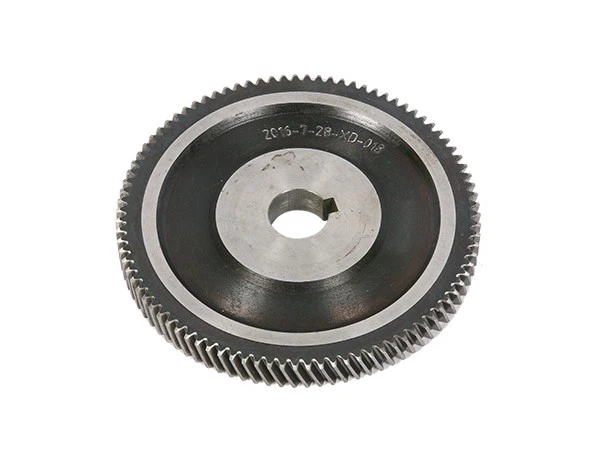

At our company, we are committed to using the latest techniques and technologies to calculate stress distribution in internal gears. We understand the importance of providing high - quality gears that meet our customers' specific requirements. Whether you need a Helical Gear, a Precision Spur Gear, or an Internal Gear, we have the expertise and experience to deliver.
If you are interested in our internal gears or have any questions about stress distribution calculation, please feel free to contact us for a procurement discussion. We look forward to working with you to find the best gear solutions for your applications.
References
- Dudley, D. W. (1962). Gear Handbook. McGraw - Hill.
- Mott, R. L. (2004). Machine Elements in Mechanical Design. Prentice Hall.
- Shigley, J. E., & Mischke, C. R. (2001). Mechanical Engineering Design. McGraw - Hill.