

What is the electrical time constant of a brushless DC motor?
May 19, 2025
Hey there! As a supplier of brushless DC motors, I often get asked about the electrical time constant of these motors. It's a pretty important concept, so I thought I'd break it down for you in this blog post.
Let's start with the basics. A brushless DC motor, as the name suggests, is a type of DC motor that doesn't use brushes. Instead, it uses electronic commutation to control the flow of current through the motor windings. This makes brushless DC motors more efficient, reliable, and durable compared to traditional brushed DC motors.
Now, what exactly is the electrical time constant? Well, it's a measure of how quickly the current in the motor windings can change in response to a change in voltage. In simpler terms, it tells us how fast the motor can "react" to changes in the electrical input.
The electrical time constant, usually denoted as τ (tau), is calculated using the formula τ = L/R, where L is the inductance of the motor windings and R is the resistance of the windings. Inductance is a property of the motor windings that opposes changes in current, while resistance is a measure of how much the windings resist the flow of current.
So, why is the electrical time constant important? For starters, it affects the motor's response time. A motor with a small electrical time constant can change its current quickly, which means it can respond rapidly to changes in the input voltage. This is particularly useful in applications where quick acceleration and deceleration are required, such as in robotics or high - speed automation systems.
On the other hand, a motor with a large electrical time constant will take longer to change its current. This can be an advantage in some applications where a more gradual change in speed is desired, like in some industrial conveyor systems.
Let's take a closer look at how the inductance and resistance affect the electrical time constant.
Inductance (L)
The inductance of the motor windings depends on several factors, including the number of turns in the windings, the cross - sectional area of the windings, and the magnetic properties of the core material. Motors with more turns in the windings generally have higher inductance. This is because each turn of the winding creates a magnetic field, and the more turns there are, the stronger the overall magnetic field and the higher the inductance.
Higher inductance means that the motor will resist changes in current more strongly. So, if you have a motor with high inductance, it will have a larger electrical time constant and will take longer to reach its steady - state current when a voltage is applied.

Resistance (R)
The resistance of the motor windings is mainly determined by the material of the wire used in the windings and the length and cross - sectional area of the wire. Materials with higher resistivity, like nichrome, will result in higher resistance. Also, longer and thinner wires will have higher resistance compared to shorter and thicker wires.
A higher resistance means that the motor will draw less current for a given voltage. In terms of the electrical time constant, a higher resistance will result in a smaller time constant. This is because the ratio L/R will be smaller when R is larger.

Now, as a brushless DC motor supplier, we offer a wide range of motors with different electrical time constants to suit various applications. For example, our 24V Brushless Dc Motor is designed for applications where a relatively fast response time is required. It has a carefully optimized combination of inductance and resistance to achieve a small electrical time constant, allowing it to accelerate and decelerate quickly.
If you need a motor with more torque and a more gradual speed change, our Brushless DC Gear Motor might be the right choice. The gearbox in this motor can also affect the overall performance characteristics, and the motor itself is designed with an appropriate electrical time constant to work well with the gear system.
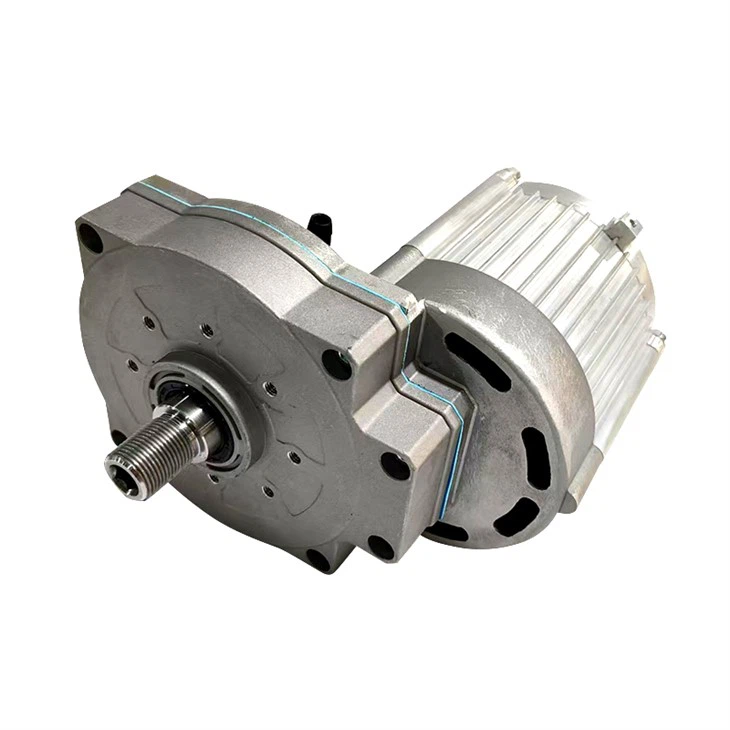
Our Brushless DC Electric Motor is another versatile option. It can be used in a variety of applications, from small consumer electronics to industrial machinery. We've engineered it to have an electrical time constant that balances between fast response and stable operation.
When choosing a brushless DC motor for your application, it's important to consider the electrical time constant along with other factors such as torque, speed, and power requirements. If you're not sure which motor is the best fit for your project, don't hesitate to reach out to us. Our team of experts is always ready to help you select the right motor and provide you with all the technical support you need.
We understand that every application is unique, and we're committed to providing you with high - quality brushless DC motors that meet your specific needs. Whether you're working on a small DIY project or a large - scale industrial application, we've got the motors and the expertise to make your project a success.

So, if you're in the market for a brushless DC motor, contact us today to start the procurement process. We're eager to have a detailed discussion with you about your requirements and find the perfect motor solution for you.
References
- Fitzgerald, A. E., Kingsley, C., & Umans, S. D. (2003). Electric Machinery. McGraw - Hill.
- Chapman, S. J. (2012). Electric Machinery Fundamentals. McGraw - Hill.