

What is the surface finish requirement for a spline shaft?
Dec 01, 2025
Hey there! As a supplier of spline shafts, I often get asked about the surface finish requirements for these crucial components. In this blog, I'll break down what those requirements are, why they matter, and how they can impact the performance of your machinery.
First off, let's talk about what a spline shaft is. A spline shaft is a mechanical component that has ridges or teeth (splines) machined onto its surface. These splines fit into corresponding grooves in a mating part, like a gear or a coupling, allowing for the transfer of torque and rotational motion. They're used in a wide range of applications, from automotive transmissions to industrial machinery.
Now, onto the surface finish requirements. The surface finish of a spline shaft refers to the texture and smoothness of its surface. It's typically measured in terms of roughness average (Ra), which is the arithmetic average of the absolute values of the surface height deviations from the mean line. The lower the Ra value, the smoother the surface.
So, why does the surface finish matter? Well, a smooth surface finish can have a significant impact on the performance and longevity of a spline shaft. Here are a few reasons why:
Reduced Friction and Wear
A smooth surface finish reduces friction between the spline shaft and the mating part. This means less energy is wasted as heat, and the components wear out more slowly. Over time, this can lead to lower maintenance costs and longer service life for your machinery.
Improved Load Distribution
A smooth surface helps to distribute the load evenly across the splines. This reduces stress concentrations and minimizes the risk of fatigue failure. In high-torque applications, proper load distribution is crucial for ensuring the reliability of the spline shaft.
Better Sealing
In some applications, a smooth surface finish is necessary for proper sealing. For example, in hydraulic systems, a smooth spline shaft surface can prevent fluid leakage and ensure efficient operation.
Enhanced Corrosion Resistance
A smooth surface is less likely to trap moisture and contaminants, which can cause corrosion. By maintaining a smooth surface finish, you can protect the spline shaft from rust and other forms of corrosion, extending its lifespan.
Now that we understand why surface finish is important, let's talk about the specific requirements for different applications.
Automotive Applications
In automotive transmissions, spline shafts are subjected to high loads and speeds. As a result, they require a very smooth surface finish to minimize friction and wear. Typically, the Ra value for automotive spline shafts ranges from 0.4 to 1.6 micrometers.
Industrial Machinery
Industrial machinery applications can vary widely in terms of load, speed, and operating conditions. For general-purpose industrial applications, a surface finish with an Ra value of 1.6 to 3.2 micrometers is often sufficient. However, in high-precision applications, such as CNC machines, a smoother surface finish may be required.
Aerospace Applications
Aerospace applications demand the highest level of performance and reliability. Spline shafts used in aircraft engines and other critical components must have an extremely smooth surface finish to ensure optimal performance. The Ra value for aerospace spline shafts is typically less than 0.4 micrometers.
So, how do we achieve the desired surface finish for spline shafts? There are several machining processes that can be used, including:
Grinding
Grinding is a common method for achieving a smooth surface finish on spline shafts. It involves using an abrasive wheel to remove small amounts of material from the surface of the shaft. Grinding can produce very precise surface finishes, but it can also be time-consuming and expensive.
Honing
Honing is another process that can be used to improve the surface finish of spline shafts. It involves using a honing tool with abrasive stones to remove material and create a smooth, uniform surface. Honing is often used for finishing spline shafts after grinding to achieve a higher level of precision.
Polishing
Polishing is a finishing process that uses a polishing compound and a rotating wheel to create a mirror-like surface finish. While polishing can produce a very smooth surface, it is typically used for aesthetic purposes or in applications where a high level of surface smoothness is required.
As a spline shaft supplier, we have the expertise and equipment to meet the surface finish requirements of a wide range of applications. Whether you need a spline shaft for an automotive transmission, industrial machinery, or aerospace application, we can provide a high-quality product that meets your specifications.
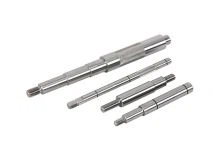

In addition to spline shafts, we also offer a variety of other types of shafts, including Worm Drive Shaft, Electric Motor Shaft, and Servo Motor Shaft. Our team of engineers and technicians can work with you to determine the best shaft solution for your specific needs.
If you're in the market for a spline shaft or any other type of shaft, we'd love to hear from you. Contact us today to discuss your requirements and get a quote. We're committed to providing our customers with the highest quality products and the best possible service.
References
- "Mechanical Design Handbook" by Robert C. Juvinall and Kurt M. Marshek
- "Machining and Machine Tools" by P. N. Rao
- "Surface Engineering for Corrosion and Wear Resistance" by R. Arul Kumar and R. S. K. Rajam