

What are the common machining operations for a shaft?
Oct 28, 2025
As a shaft supplier, I've had the privilege of being deeply involved in the manufacturing and machining processes of shafts. Shafts are fundamental components in numerous mechanical systems, from automotive engines to industrial machinery. Understanding the common machining operations for a shaft is crucial not only for manufacturers but also for those looking to source high - quality shafts. In this blog, I'll delve into the most prevalent machining operations used in shaft production.
Turning
Turning is perhaps the most basic and widely used machining operation for shafts. It involves rotating the shaft on a lathe while a cutting tool is fed against it to remove material. The lathe is a versatile machine that can create various features on a shaft, such as cylindrical surfaces, tapers, and grooves.
One of the key advantages of turning is its ability to achieve high precision. By carefully controlling the speed of rotation, the feed rate of the cutting tool, and the depth of cut, we can produce shafts with tight tolerances. For example, in the production of Precision Gearbox Shafts, turning is used to create the smooth cylindrical surfaces that are essential for proper gear meshing.
There are different types of turning operations. Facing is used to create a flat surface at the end of the shaft. This is important for ensuring a proper fit with other components. Straight turning, on the other hand, is used to reduce the diameter of the shaft along its length. Taper turning can be employed to create a shaft with a gradually changing diameter, which is useful in applications where a specific fit or alignment is required.
Drilling
Drilling is another essential machining operation for shafts. It is used to create holes in the shaft, which can serve various purposes. For instance, holes can be used for lubrication channels, for mounting other components, or for electrical wiring in the case of Electric Motor Shaft.
When drilling a shaft, it's important to use the right drill bit and drilling parameters. The drill bit should be selected based on the material of the shaft and the size of the hole required. High - speed steel (HSS) drill bits are commonly used for softer materials, while carbide drill bits are more suitable for harder materials.
The drilling process also requires careful control of the feed rate and the rotational speed. Too high a feed rate can cause the drill bit to break, while too low a feed rate can result in a poor - quality hole. Additionally, proper cooling and lubrication are necessary to prevent overheating of the drill bit and to ensure a smooth drilling operation.
Boring
Boring is a machining operation that is used to enlarge an existing hole in a shaft. It can also be used to improve the accuracy and surface finish of the hole. Boring is often performed after drilling to achieve the desired hole diameter and tolerance.
In boring, a single - point cutting tool is used to remove material from the inner surface of the hole. The cutting tool is fed along the axis of the hole while the shaft rotates. Boring can be done on a lathe or a boring machine. On a lathe, the boring bar is mounted in the tool post, and the shaft is rotated. On a boring machine, the shaft is held stationary, and the boring bar rotates.
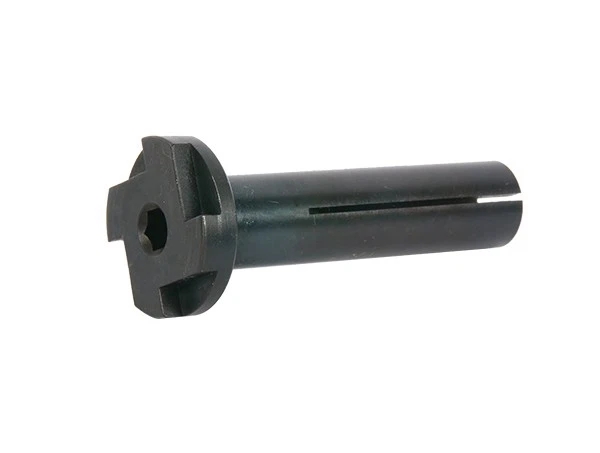

Boring is particularly important in applications where precise hole dimensions are required, such as in the production of Precision Shaft Sleeve. A well - bored hole ensures a proper fit between the shaft and the sleeve, which is essential for the smooth operation of the mechanical system.
Milling
Milling is a machining operation that uses a rotating multi - point cutting tool to remove material from the shaft. It can be used to create flat surfaces, slots, keyways, and other complex features on the shaft.
There are different types of milling operations. Face milling is used to create a flat surface on the end or the side of the shaft. Peripheral milling, on the other hand, is used to remove material from the outer surface of the shaft. Slot milling is used to create slots or grooves in the shaft, which can be used for keyways or for mounting other components.
Milling offers a high degree of flexibility in terms of the features that can be created on the shaft. However, it requires more complex machinery and programming compared to turning and drilling. The cutting parameters, such as the feed rate, the cutting speed, and the depth of cut, need to be carefully controlled to ensure a high - quality finish.
Grinding
Grinding is a finishing operation that is used to achieve a high - precision surface finish and tight tolerances on the shaft. It involves using an abrasive wheel to remove a small amount of material from the surface of the shaft.
There are different types of grinding operations. Cylindrical grinding is used to grind the outer surface of the shaft. Centerless grinding is a specialized form of cylindrical grinding that does not require the shaft to be centered between centers. This makes it suitable for high - volume production.
Surface grinding can be used to create a flat surface on the end or the side of the shaft. Internal grinding is used to grind the inner surface of holes in the shaft. Grinding is often used as a final operation to improve the dimensional accuracy and the surface finish of the shaft, especially in applications where high - precision is required.
Threading
Threading is a machining operation that is used to create threads on the shaft. Threads can be used for fastening other components to the shaft or for adjusting the position of components.
There are different methods of threading. Single - point threading is a traditional method that uses a single - point cutting tool to create the threads. This method is suitable for low - volume production and for creating custom - sized threads.
Tapping is another method of threading, which is used to create internal threads in holes. It involves using a tap to cut the threads in the hole. Thread milling is a more modern method that uses a rotating milling cutter to create threads. It offers greater flexibility and can be used to create threads in a wider range of materials and sizes.
Heat Treatment
Although not strictly a machining operation, heat treatment is an important process in shaft manufacturing. Heat treatment can be used to improve the mechanical properties of the shaft, such as hardness, strength, and toughness.
Common heat treatment processes for shafts include annealing, quenching, and tempering. Annealing is used to soften the shaft material, which can make it easier to machine. Quenching involves rapidly cooling the shaft from a high temperature to increase its hardness. Tempering is then used to reduce the brittleness that can be caused by quenching and to improve the toughness of the shaft.
Heat treatment needs to be carefully controlled to ensure that the desired mechanical properties are achieved. The heating and cooling rates, the temperature, and the duration of the heat treatment process all need to be optimized based on the material of the shaft and the specific application requirements.
Conclusion
In conclusion, the machining operations for a shaft are diverse and complex. Each operation plays a crucial role in creating a high - quality shaft that meets the specific requirements of different applications. As a shaft supplier, we have the expertise and the equipment to perform all these machining operations with precision and efficiency.
If you're in the market for high - quality shafts, whether it's Precision Gearbox Shafts, Electric Motor Shaft, or Precision Shaft Sleeve, we'd be more than happy to discuss your needs. Our team of experts can assist you in selecting the right materials, machining processes, and heat treatment methods to ensure that you get the best - performing shafts for your mechanical systems. Contact us to start a procurement discussion and let us help you find the perfect shaft solutions for your applications.
References
- "Machining Fundamentals" by John A. Schey
- "Manufacturing Engineering and Technology" by Serope Kalpakjian and Steven R. Schmid
- "Modern Manufacturing Processes" by Robert L. Norton