

What is the mechanical time constant of a brushless DC motor?
Nov 19, 2025
As a supplier of brushless DC motors, I often get asked about various technical specifications of our products. One of the key parameters that customers frequently inquire about is the mechanical time constant of a brushless DC motor. In this blog post, I'll delve into what the mechanical time constant is, why it matters, and how it relates to the performance of our brushless DC motors.
Understanding the Mechanical Time Constant
The mechanical time constant, denoted as τm, is a fundamental characteristic of a motor that describes its dynamic response. Specifically, it represents the time it takes for the motor to reach approximately 63.2% of its final speed when a constant voltage is applied, starting from rest. This concept is analogous to the time constant in an RC (resistor - capacitor) circuit, which describes how quickly the capacitor charges to a certain voltage level.
Mathematically, the mechanical time constant can be expressed as:
[ \tau_m=\frac{J \cdot R}{K_T \cdot K_E} ]
where:
- (J) is the moment of inertia of the motor and load combined, measured in (kg\cdot m^2). It represents the resistance of the motor and load to changes in rotational speed. A higher moment of inertia means that it takes more energy to accelerate or decelerate the system.
- (R) is the armature resistance of the motor, measured in ohms ((\Omega)). The armature resistance affects the current flow in the motor windings and, consequently, the torque produced.
- (K_T) is the torque constant of the motor, measured in (N\cdot m/A). It relates the current flowing through the motor to the torque produced. A higher torque constant means that the motor can produce more torque for a given current.
- (K_E) is the back - EMF constant of the motor, measured in (V/(rad/s)). The back - EMF is the voltage generated by the motor as it rotates, which opposes the applied voltage. A higher back - EMF constant means that the motor generates more back - EMF for a given rotational speed.
Why the Mechanical Time Constant Matters
The mechanical time constant is a crucial parameter because it provides valuable insights into the motor's performance characteristics. Here are some key reasons why it is important:
1. Response Time
The mechanical time constant directly affects the motor's response time. A smaller time constant means that the motor can reach its final speed more quickly, making it suitable for applications that require rapid acceleration and deceleration, such as robotics, CNC machines, and high - speed automation systems. On the other hand, a larger time constant indicates a slower response, which may be acceptable for applications with less demanding dynamic requirements, like conveyor belts or fans.
2. Stability
In control systems, the mechanical time constant plays a vital role in determining the stability of the motor. When designing a control algorithm for a brushless DC motor, engineers need to consider the time constant to ensure that the system does not become unstable or exhibit excessive oscillations. A well - designed control system can compensate for the motor's time constant to achieve smooth and precise operation.
3. Energy Efficiency
The mechanical time constant also has implications for energy efficiency. Motors with a smaller time constant can accelerate and decelerate more efficiently, reducing the energy wasted during transient operations. This is particularly important in applications where energy consumption is a major concern, such as electric vehicles and battery - powered devices.
Mechanical Time Constant and Our Brushless DC Motors
At our company, we offer a wide range of brushless DC motors, each with its own unique mechanical time constant tailored to specific applications. Let's take a look at some of our popular products and how their mechanical time constants impact their performance.
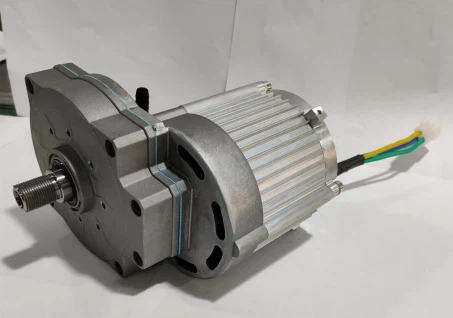

24V Brushless DC Gear Motor
Our 24V brushless DC gear motors are designed for applications that require high torque at low speeds. These motors typically have a relatively larger moment of inertia due to the presence of the gearbox, which results in a larger mechanical time constant. While this may mean a slower response time compared to some other motors, it also allows the motor to provide stable and reliable torque output, making it ideal for applications such as industrial automation, medical equipment, and home appliances.
Small Brushless Dc Motor
Our small brushless DC motors are known for their compact size and high power density. These motors have a relatively small moment of inertia, which results in a smaller mechanical time constant. As a result, they can respond quickly to changes in input signals, making them suitable for applications that require rapid acceleration and precise control, such as drones, robotics, and small - scale automation systems.
36V Brushless Dc Motor
Our 36V brushless DC motors are designed for applications that require higher power and performance. These motors typically have a lower armature resistance and a higher torque constant, which can help to reduce the mechanical time constant. This allows the motor to reach its final speed more quickly, making it suitable for applications such as electric vehicles, high - speed fans, and industrial machinery.
Factors Affecting the Mechanical Time Constant
Several factors can affect the mechanical time constant of a brushless DC motor. Understanding these factors can help you select the right motor for your application and optimize its performance.
1. Load Inertia
As mentioned earlier, the moment of inertia of the motor and load combined has a significant impact on the mechanical time constant. Adding a heavy load to the motor increases the moment of inertia, which in turn increases the time constant. Therefore, it is important to consider the load requirements when selecting a motor and to ensure that the motor has sufficient torque and power to drive the load effectively.
2. Motor Design
The design of the motor, including the number of poles, winding configuration, and magnetic materials used, can also affect the mechanical time constant. For example, a motor with a higher number of poles may have a lower back - EMF constant, which can result in a smaller time constant. Similarly, using high - performance magnetic materials can increase the torque constant, which can also help to reduce the time constant.
3. Control Strategy
The control strategy used to drive the motor can also influence its dynamic response. Advanced control algorithms, such as field - oriented control (FOC), can optimize the motor's performance by adjusting the current and voltage applied to the motor based on its operating conditions. This can help to reduce the mechanical time constant and improve the motor's response time.
Conclusion
In conclusion, the mechanical time constant is a critical parameter that affects the performance, response time, stability, and energy efficiency of a brushless DC motor. As a supplier of brushless DC motors, we understand the importance of this parameter and offer a wide range of motors with different mechanical time constants to meet the diverse needs of our customers.
Whether you are looking for a 24V Brushless DC Gear Motor for industrial automation, a Small Brushless Dc Motor for robotics, or a 36V Brushless Dc Motor for high - performance applications, we have the right solution for you.
If you have any questions about the mechanical time constant or need help selecting the right motor for your application, please feel free to contact us. Our team of experts is always ready to assist you in finding the best motor solution for your specific requirements.
References
- Krause, P. C., Wasynczuk, O., & Sudhoff, S. D. (2013). Analysis of electric machinery and drive systems. Wiley.
- Chapman, S. J. (2012). Electric machinery fundamentals. McGraw - Hill.