

How to calculate the natural frequency of a gear shaft?
Mar 25, 2026
Hey there! As a gear shaft supplier, I often get asked about how to calculate the natural frequency of a gear shaft. It's a crucial aspect in the design and performance of gear systems, and today, I'll walk you through the process step by step.
Why Natural Frequency Matters?
Before we dive into the calculation, let's quickly understand why knowing the natural frequency of a gear shaft is so important. Natural frequency is the frequency at which a system tends to oscillate in the absence of any driving or damping force. When external forces, such as vibrations from the motor or load variations, match the natural frequency of the gear shaft, resonance occurs. Resonance can lead to excessive vibrations, increased stress on the shaft, and ultimately, premature failure of the gear system. So, by calculating the natural frequency, we can ensure that the gear shaft operates safely and efficiently outside the range of potential resonance frequencies.
Simplified Model: The Single - Degree - of - Freedom (SDOF) Approach
The easiest way to start calculating the natural frequency of a gear shaft is by using the single - degree - of - freedom model. In this model, we consider the gear shaft as a simple spring - mass system. The mass represents the inertia of the rotating parts of the gear shaft, and the spring represents the shaft's flexibility.
The formula for the natural frequency ((f_n)) of a single - degree - of - freedom system in Hz is given by:
(f_n=\frac{1}{2\pi}\sqrt{\frac{k}{m}})
where (k) is the stiffness of the shaft (in N/m) and (m) is the mass (in kg).
Let's break down how to determine the stiffness ((k)) and mass ((m)) of the gear shaft.
Determining the Mass ((m))
The mass of the gear shaft mainly consists of the mass of the shaft itself, the gears attached to it, and any other rotating components. To calculate the mass, you first need to know the density ((\rho)) of the material used for the shaft and the geometric dimensions of the shaft and gears.
The volume ((V)) of a solid cylindrical shaft with length (L) and radius (r) is given by (V=\pi r^{2}L). The mass of the shaft ((m_{shaft})) is then (m_{shaft}=\rho V=\rho\pi r^{2}L).

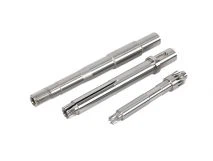
For the gears, you can use similar principles based on their geometric shapes. If the gears have complex shapes, you might need to use more advanced techniques like CAD software to calculate their volumes and then multiply by the density to get the mass. Once you have the mass of all the rotating components, you simply add them up to get the total mass ((m)) of the system.
Determining the Stiffness ((k))
The stiffness of the gear shaft is a measure of how much it resists deformation under an applied load. For a simply - supported shaft with a concentrated load at the center, the stiffness can be calculated using the following formula:
(k = \frac{48EI}{L^{3}})
where (E) is the modulus of elasticity of the shaft material (in Pa), (I) is the area moment of inertia of the shaft's cross - section (in (m^{4})), and (L) is the length of the shaft (in m).
The area moment of inertia for a solid circular shaft of radius (r) is (I=\frac{\pi r^{4}}{4}).
More Complex Models
The single - degree - of - freedom model is a great starting point, but in real - world applications, gear shafts are often more complex. They may have multiple gears, different cross - sectional shapes along the length, and be supported in various ways.
One common approach for more complex systems is the finite element method (FEM). FEM software can create a detailed 3D model of the gear shaft, taking into account its exact geometry, material properties, and boundary conditions. The software then solves a set of equations to determine the natural frequencies and mode shapes of the system.
Applications of Calculating Natural Frequency
Understanding the natural frequency of a gear shaft is not just a theoretical exercise. It has practical applications in various industries.
For example, in the automotive industry, gear shafts are used in transmissions and drivetrains. By calculating the natural frequencies, engineers can design gear systems that are less prone to vibrations and noise, providing a smoother and more comfortable driving experience.
In the aerospace industry, where weight and performance are critical, accurate calculation of natural frequencies helps in designing lightweight yet robust gear shafts for aircraft engines and other systems.
Types of Gear Shafts and Their Natural Frequencies
As a gear shaft supplier, I deal with different types of gear shafts, each with its own unique characteristics and natural frequencies.
- Internal Spline Shaft: These shafts have internal splines that allow for a positive connection between the shaft and other components. The shape of the internal splines can affect the shaft's stiffness and mass distribution, thus influencing its natural frequency.
- Electric Motor Shaft: Electric motor shafts need to transmit power efficiently from the motor to the load. The design of these shafts takes into account the high - speed rotation and the electromagnetic forces acting on them, which can change the natural frequency compared to other types of shafts.
- Precision Gearbox Shafts: Gearbox shafts need to have very precise dimensions and high - quality materials to ensure accurate gear meshing. The precision manufacturing can affect the shaft's natural frequency due to the tight tolerances and reduced variability in the material properties.
Tips for Controlling Natural Frequency
Once you've calculated the natural frequency of a gear shaft, you may find that it falls within a range where resonance could be a problem. Here are some ways to control the natural frequency:
- Change the mass: Adding or removing mass from the shaft or its attached components can shift the natural frequency. For example, adding a balancing weight can change the mass distribution and thus the natural frequency.
- Alter the stiffness: Changing the shaft's cross - sectional area or material can affect its stiffness. Using a material with a higher modulus of elasticity or increasing the diameter of the shaft can increase the stiffness and raise the natural frequency.
Contact Us for Your Gear Shaft Needs
Calculating the natural frequency of a gear shaft is a complex but essential process. As a gear shaft supplier, we have the expertise and experience to help you with all your gear shaft requirements. Whether you need a custom - designed gear shaft or want to optimize the natural frequency of an existing design, we're here to assist you. If you're interested in discussing your project or making a purchase, feel free to reach out to us. We look forward to working with you to ensure the success of your gear systems.
References
- Meirovitch, L. (1986). Elements of Vibration Analysis. McGraw - Hill.
- Inman, D. J. (2014). Engineering Vibration. Prentice Hall.